 |
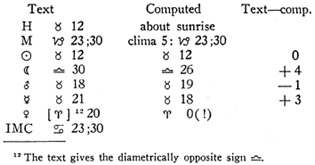 In the Astronomical Commentary on the Rhetorian text, next to the table at right, the same authors write: “From the incomplete data of this horoscope, one can nevertheless deduce as a plausible date 516 May 1, in agreement with the time of Rhetorius. The omission of Jupiter and Saturn deprives us of the most important element for a definitive date. The incomplete example of CCAG 8,1 p. 229,14 which also uses clima 5, H = ♉ 12, M = ♑ 23 places Jupiter in ♋ 11. In May 516 Jupiter was, however, in ♓ 25. Thus we must assume that either the two examples are independent, ot that we are dealing with a fictitious example, as probably is the case also with Nos. L 401 and L 488 from Rhetorius.”
Horoscopos 12° Aries;[3] Midheaven 23°30' Capricorn; clima V. Sun 12° Taurus; Moon 30° Libra; Mars 18° Taurus; Mercury 21° Taurus; Venus 20° Libra.[4] I am looking for the directional mission (τὴν ἄφεσιν) of the Moon, which is in 30° Libra, that is when it contacts each of them. This way: hypogeum 23°30' Cancer, time-degrees in Sphaera recta 205°26'; Moon 29° Libra, in Sphaera recta 297°; excess 91°34'; nocturnal hourly times of the Moon 16°43'; divide 91°34' by 16°43': it makes about 5½ local-temporal hours; so such are the hours which distance the Moon from the hypogean centre. Now, you have to find when the Moon connects up with the diameter of the Sun. Diameter of the Sun 12° Scorpio; (its) anaphora in Sphaera recta 309°28'; hypogeum 23°30' Cancer, in Sphaera recta 205°26', excess 104°02';[5] Time-degrees of the Sun 17°21'; multiply this 17°21' by 5 temporal-local hours and 28m: it makes 94°37' time-degrees; subtract these from 104°02'; remainder 9°25'. So, I say that the Moon diametrically connected with the Sun after 9 years and about 2 months.[6]
Again, diameter of Mars 18° Scorpio, in Sphaera recta 315°28'; excess in regard to hypogeum 110°02'; diurnal time-degrees of Mars 17°38'; multiply this by the 5½ temporal-local hours, which distance the Moon: it makes 97° time-degrees;[7] subtract this from 110°02': remainder 13°. So, I say that the Moon diametrically connected with Mars after 13 years, and Mars took from the Moon the (rule of the) times and became chronocrator.
Again, diameter of Mercury 21° Scorpio, in Sphaera recta 318°29'; together with hypogeum were ascending 205°26', excess 113°03'; diurnal time-degrees of Mercury 17°46'; multiply this by the 5½ temporal-local hours: it makes 97°43';[8] Subtract this from 113°03': remainder 15°20'. Tell then that the Moon contacts with the diameter of Mercury after 19 years and 4 months.[9]
Hypogeum 23° Cancer; Moon in the VI place, 29° Libra; clima V. With the 23° degree of Cancer, 207° 26' times arise (on the straight sphere); 297° times arise with the Moon; the excess is 91°44' times; nocturnal times of the Moon 16°43'; divide the 93°40' by these: that makes approximately 5 and a half temporal-local hours, which distance the Moon from the underground antimeridian.
(In the Sphaera obliqua) with the Moon's diameter rise 17° [16°55'] degrees;[12] subtract 120 times of the trigonal side: the remainder is 257° [17°-120° = 257°]. (Rising in the Sphaera obliqua) the corresponding degrees [i.e., 30° Scorpio (more precisely, 0°06' Sagittarius)], the diametrically opposite degrees, (i.e.) 30° Taurus [0°06' Gemini], are setting[13]. In this position, therefore, 30° Taurus [0°06' Gemini] is the right trigonal side of the Moon.
πάλιν, συναντιμεσουρανεῖ ἡ Σελήνη Ζυγοῦ μοί(ραις) κθ'. χρ(όνοι) σϟζ΄. ἄφε(λε) ρκ', τὴν τριγωνικὴν πλευράν, λοιπ(ὸν) χρ(όνοι) ροζ'. ταῖς δὲ ροζ' μοίραις συμμεσουρανοῦσι Διδύμων κζ'· κατὰ τὴν θέσιν ἄρα ταύτην ἡ τῶν Διδύμων μοῖ(ρα) κζ' τριγωνική ἐστι τῇ Σελήνῃ· ὑπεροχὴ τῶν β' θέσεων μοῖ(ραι) κη'. ὧν τὸ ἕκτον διὰ τὸ ἑξάωρον γίνονται χρ(όνοι) δ' μ'. τὰ δ' μ' πολυπλασίασον ἐπὶ τὰς καιρικὰς ὥρας· γίν(ονται) χρ(όνοι) κϛ'. ταῦτα πρόσθες τῷ ἥττονι, τουτέστι τῇ τοῦ Ταύρου μοίρᾳ λ', γίν(ονται) <Διδύμων> κϛ' τρίγωνον δεξιὸν Σελήνης.
Again (on the Sphaera recta), to the Moon counter-rises 117° [116°53'] Aries; subtract 120° from the trigonal side and the remainder is 357° [356°53'], opposite on the Sphaera recta there are 177° [176°53']; with these 177° degrees rise 28° Gemini. The excess between the two positions is 28° [27°10'] for the 6-hour quadrant; one sixth is 4°40' [4°31'40"]; multiply by the hourly distance of the Moon, 5h28m, and you get 25°(31') [24°45']; add them to the smaller number, that is, 30° Taurus [0°06' Gemini], and you get 25° [24°51'] Gemini, where the right trine of the Moon falls
Horoscope 12° Taurus; Midheaven 23° Capricorn; clima V. Jupiter 11° Cancer; with 23° Capricorn rise 24°54'; the times rising with 11° Cancer are 192°; excess 167° [167°06']; Jupiter's diurnal hour is 18°39', which starting from the six-hour quadrant above the earth [i.e., a diurnal semiarc] make 112° times; subtract these from 167°, the remainder is 55° [55°06']. Jupiter's nocturnal hour is 11°21' [i.e., 30°-18°39'=11°21']: divide the 55° by these, and having divided (καὶ μερίσας) them, the result is approximately 4 + ½ +⅓ local-temporal hours. Therefore, Jupiter is approximately 4 + ½ + ⅓ local-temporal hours away from the horoscope. With Jupiter co-ascend (in the Sphaera obliqua) 80°(03'); subtract from these 120° of the right trine: remainder 320°. At 320° co-ascend (in the Sphaera obliqua) 29° Capricorn. In this position therefore lies the right trigonal side of Jupiter, (i.e.) 29° Capricorn. (We said above that in the Sphaera recta) with Jupiter rise 192°; subtract 120° of the trigonal side; the remainder is 72°; with these 72° co-ascend (in the Sphaera recta) 11° Pisces. In this position therefore the right trigonal side with respect to (πρὸς τὸν) Jupiter is positioned at 11° Pisces. Excess between the two positions, 42°; the sixth of these is 7°; multiply the 7° by 4°51' local-temporal hours, which distance Jupiter from the horoscope: it makes 33°57' times; add these to the 29°, the result is 63°; I therefore give 30° to Capricorn and 30° to Aquarius and (the calculation) ends at 3° Pisces, and at 3° Pisces the (right) trine of Jupiter is placed.
Now let the horoscope be placed as apheta at 12° Taurus; midheaven 23°30' Capricorn;[14] anaphoric time on the Sphaera (recta) 25°26'; Saturn at {9}7°46'.[15] We must find after how many times the subsequent <hexagonal> side of Saturn will meet the apheta, that is, 12° Taurus. Taking the degrees that co-rise with Saturn on the Sphaera recta, 97°07', subtracted from which the 25°26' degrees of Capricorn, the remainder (are) the degrees of the excess [λοιπὸν μένουσαι τῆς ὑπεροχῆς μοῖ(ραι)] 71°41'. (We know that) the apheta is 104°02' times from the midheaven.[16] Saturn, therefore, is 32°21' from the horoscope. Its diurnal times in the given clima are 15°26'; I divide 71°41' by 15°26': the result is 4h ½+¹/12+¹/15 (= 4h 39m).[17] Since I am looking for when the subsequent hexagonal degree of Saturn joins the apheta, to the 97°07' of Saturn (co-rising) with the midheaven I add 60° of the hexagonal side, and it makes 157°07', approximately 9° Gemini [8°58']. Therefore the subsequent hexagonal side of Saturn is placed along the sphere at approximately 9° Gemini.
Again (on the Sphaera obliqua): to Saturn's position in the fifth clima correspond anaphoric times of approximately 4°26' [4°24']. To these I add 60° to find the hexagon: they make 64°; and to the 64° (of oblique ascension) correspond approximately 27°0' Gemini.[18] The following hexagonal side of Saturn in this position of the horoscope[19] holds[20] approximately 27°0' Gemini, but according to that of the meridian it falls at approximately 9° Gemini. In the six-hour quadrant the first position differs from the second by 18°. Therefore, at each hour, each subsequent position will differ (from the previous one) by 3°. Saturn is approximately 4+½+¹/12+¹/15 local-temporal hours from the meridian. Saturn accumulates a difference, related to 4h+½+¹/12+¹/15, of approximately 14°.[21] Add these 14° degrees to the previous degree of Gemini, that is, the 9th degree: they result in 23° Gemini. I add them because the 9° hexagonal degrees of the Sphaera recta are less than the 27° horoscopic Gemini [scil. of the Sphaera obliqua]; if the degrees of the Sphaera recta had been greater, the 9°, we would have subtracted them. We move the sphere along the following (signs), until we reach the hexagonal side of Saturn at 23° Gemini. Since apheta is the horoscope at 12° Taurus, we will use the anaphoras of the horoscope and find the times, those of the hexagon, which cover approximately 24°3' [?!]. We can, therefore, reveal that after 24°44' [?!] years the hexagonal side of Saturn joins the place.
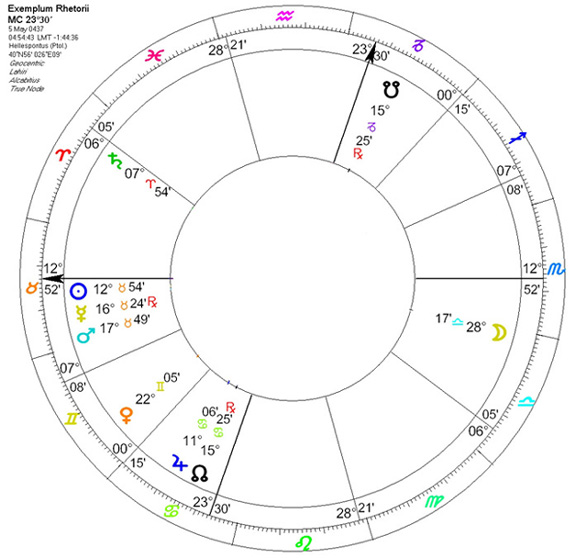 And finally, we can return to the Astronomical Commentary cited at the beginning. It is truly surprising that the authors of GH, despite having noted that the fragment on p. 229 gives Jupiter's position at 11° Cancer, failed to note that the remainder of the first fragment (p. 224,15) also gives Saturn's position at 97°46', which is—as we have seen—a clear error for 7°46' Aries. With this additional data, we can confidently date the horoscope to May 5, 437, and if we consider the planetary positions according to Lahiri's ayanamsha, we will note how all the positions correspond.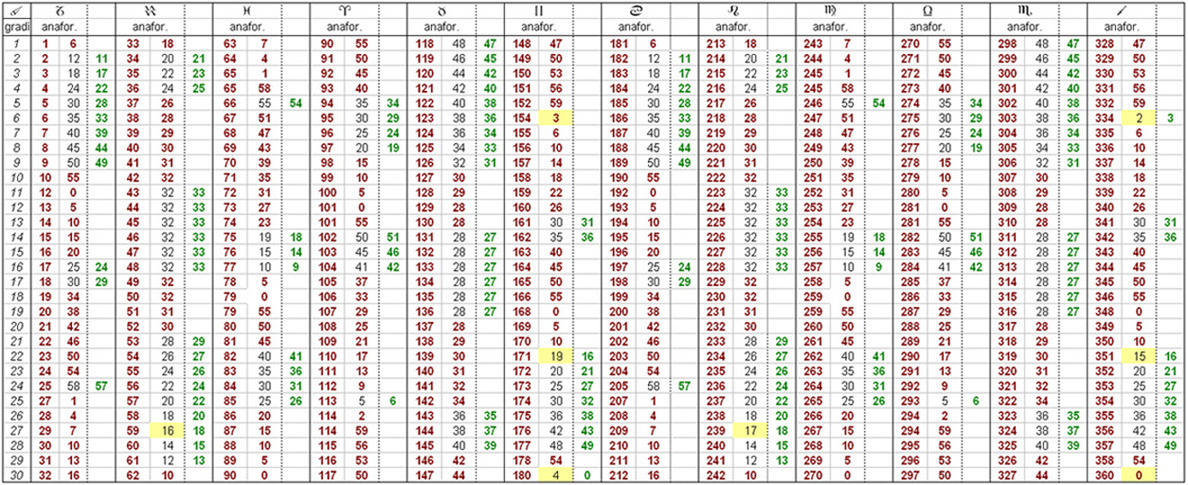
NOTES.
[1]
With the exception of chapters Nos. 12 (already translated in GH p. 138 ff.) and 13, these important texts are missing in the Compendium by James H. Holden, Rhetorius The Egyptian, Astrological Compendium, Tempe (AFA, Inc.) 42009.
[2]
Cf. O. Neugebauer and H. B. van Hoesen, Greek Horoscopes, Philadelphia 1987, p. 157 f.
[3]
The authors of GH rightly correct the text and adopt the reading from Codex V, which has 'Taurus' instead of 'Aries'.
[4]
The authors note: “This is obviously impossible if the sun is in Taurus. The fragment p. 227,19 f. gives ♊ 21 which is in trine with ♎ 2[1]. One could also think of the diametrical position ♈ 20. Computation confirms neither one of these possibilities (resulting in ♈ 0°). It is also suspicious that Venus is omitted from the astrological discussion.” The authors failed to consider that, as the symbols were already in use and the sign of Gemini was represented by two horizontal lines (═), any irregularity in the upper line could have led an incompetent copyist to read it as the sign ♎.
[5]
Actually, 104°02' is the diurnal semiarc of the Sun, which is derived from the difference between the right ascension of the MC and the right ascension of the horoscope.
[6]
Rome's calculations in the apparatus are astonishing. Since 17°21' × 5h28m does not equal 94°37'—and the error cannot be attributed to Rhetorius—, the figure must be corrected to 94°47', which, when subtracted from 104°02', gives 9°15', that is, 9 years and three months
[7]
This result is also very approximate, because, with the Sun's diameter, the distance had been specified as 5h 28m, but the subsequent subtraction agrees with 97°.
[8]
The result is correct for 5 and a half hours, not for 5h and 28m.
[9]
Here too there is an error (19 instead of 15) which the editor failed to notice!
[10]
V. supra.
[11]
Cf. Anne Tihon, Πτολεμαίου Πρόχειροι
Κανόνες, Les Tables Faciles de Ptolémée, vol. 1a, Louvain-la-Neuve 2011; il vol. 1b, con trascrizione e commento, è curato da Raymond Mercier. Il secondo volume è stato annunciato per il 2026. Si tratta di una splendida edizione; il solo neo è la traduzione di πρόχειρος con facile, che non è della Tihon, ma fu imposta da Adolphe Rome in polemica con l'abate Halma, che aveva tradotto con manuelle; πρόχειρος non significa 'facile', bensì 'di pronto utilizzo' (in francese si potrebbe dire sous la main). Prima di questa encomiabile edizione, cui facciamo riferimento, la tavola delle ascensioni nella sfera retta, che qui interessa, era stata pubblicata dal citato abate Halma (Paris 1822).
[12]
According to the editors, the Greek text reads: οἱ συνανατέλλοντες τῇ διαμέτρῳ Σελήνῃ μοί(ρᾳ) <Κριοῦ κθ' χρόνοι> ιζ'; the integration is superfluous and, given the evident manipulations of these texts, we would read αἱ συνανατέλλουσαι τῇ διαμέτρῳ τῆς Σελήνης μοῖ(ραι) ιζ', the degrees which (in the Sphaera obliqua) rise with the diameter of the Moon (are) 17.
[13]
The verb ἀποδύνω, in the sense of δύνω, 'to set', occurs only here.
[14]
Interpolating from the Ptolemaic tables, it is found that with 23°30' Capricorn, 25°25'40” degrees are rising. Now, in the fifth clima, the anaphora of 25°25'40” corresponds to 12°01'27” Taurus. Rome states in the critical apparatus that the midheaven is at 23°33', not 30', and that the error lies with Rhetorius. Actually, Rhetorius rounded the values without making any error.
[15]
The figure 9 must be expunged. For if, as is specified shortly afterwards, Saturn's ascension on the Sphaera recta is 97°07', its position can only be at 7°46' Aries.
[16]
The author takes this figure as given, based on the procedure outlined at the beginning of the chapter. Rome, who erroneously calls 'ascensio recta' the ascension on the Sphaera recta, states that that of 12° Taurus should be 129°29', but this is contradicted by the Ptolemaic tables.
[17]
That is, 4h+30m+5m+4m.
[18]
Rhetorius might seem very imprecise, but the oblique ascension of 27° Gemini is given as 64°21' in the tables, and the oblique ascension of 64°26' corresponds, again using the Ptolemaic tables, to 27°03'. As usual, A. Rome presents pointless nit-picking in his notes.
[19]
As for the expression κατὰ ταύτην τὴν θέσιν τοῦ ὡροσκόπου, it should be noted that it is not equivalent to κατὰ τὴν θέσιν τούτου τοῦ ὡροσκόπου; the same applies to κατὰ δὲ τὴν τοῦ μεσουρανήματος.
[20]
The Greek text of Codex V reads ἐπέχει, which Codex P omits. The editor, for some unknown reason, corrects this to ἀπέχει. This is truly surprising!
[21]
In reality, it is 13°57' (18°/6h × 4h39m), but in an illustrative example the discrepancy is negligible.
[22]
Since the fragment in CCAG VIII.1, p. 223, places the ascendant at 11°13', it is reasonable to suspect that the figure 13 is the result of yet another blunder on the part of the copyists.
[23]
In the article 'The house-division according to Rhetorius' we provide this table calculated using Excel, taking into account the Ptolemaic inclination of the ecliptic (23°51'20”).
© Franco Luigi Viero
INDIETRO 