 |
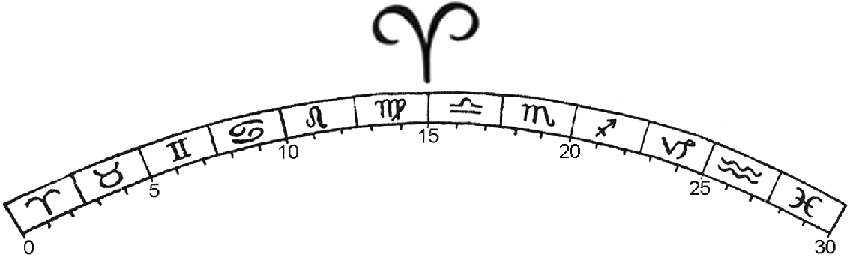
1. Some have distributed the regencies (οἰκοδεσποτεῖαι) in even smaller sectors than these (just exposed), calling them 'places' and 'degrees', and assuming as 'place' the twelfth of the twelfth, that is to say 2 and a half degrees, and assigning the lordship (κυρεία) to the signs in succession. Others, then, according to different non-rational placement criteria (κατ’ἄλλας τινὰς ἀλόγους τάξεις), have attributed each 'degree', always from the beginning (of the sign), to each of the stars, in accordance with the placement of the Chaldean districts (ὅρια). 2. Well, we will put aside this type of subdivision (τοῦτο μὲν οὖν), since it is based on an unsound and unnatural line of reasoning; instead, we will take into consideration the other one ((ἐκεῖνο δέ), which is worthy of attention, since it is reasonable to establish the solstitial and equinoctial signs as the beginnings of the dodekatemoria and the districts, and this has been clarified to some extent by those who wrote about it before us, and above all (it is reasonable) because we observe that their natures (φύσεις), powers (δυνάμεις) and coregencies (συνοικειώσεις) originate, in accordance with what has already been explained, from the beginnings of the tropics and the equinoxes and not from anything else, whatever it may be. 3. By setting other beginnings, either we will be forced in the predictions not to consider their natures at all, or, considering them, to fail, having violated and altered the distances of the zodiac that confer to them their own powers.
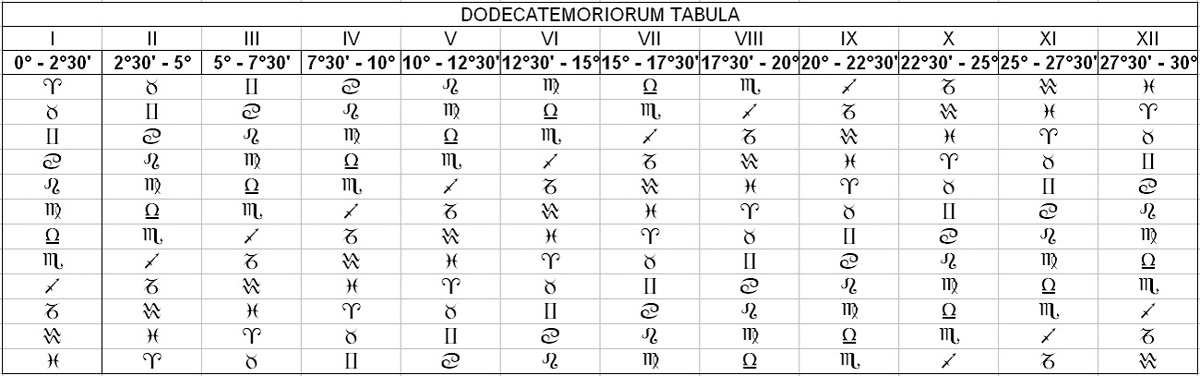
The best teacher is one who not only relates true and just principles, but also discusses false ones that can mislead the mind of a young person; well, the Venerable [scil. Ptolemy] proved himself to be such in his teaching on districts, refuting the false opinions of the Egyptians. And now he wishes to refute other principles of theirs that aim at vanity. In addition to the division of signs into districts, there were also other minor subdivisions among the Egyptians, such as that of dodekatemoria and individual degrees. Lest anyone think that he intends to ignore them, he writes about them in order to refute them as fatuous and aiming only at vainglory.[15] There were therefore such dodekatimoria among them: the degree occupied by a star, they multiplied it by twelve; to each sign they assigned 30 degrees (subtracting them from the total) and where it [scil. the remainder] ended, they said that the dodekatemorion was there. Dorotheus also does the same.[16] He, however, does not do (the multiplication) by twelve, but says that to each sign he assigned 2 degrees and ½ and, where it ended, he said that the dodekatemorion was there. He says (in the end) the same thing as Dorotheus.[17] In fact, the 2 and ½ degrees are analogous to the number 30. If we do 2 × 12, the result will be the number 24, but the 12 added half-degrees complete the number 30. As a proof that (the two calculations) agree, let us take the (first) three degrees of Aries, as Dorotheus says,[18] and, according to Ptolemy, let us give 2½ to Aries.[19] The half degree will be of Taurus, and it will be the 6th degree.[20] And the result is the same with both methods.
The Moon's dodekatemorion is computed in two ways. First, having observed how many degrees the Moon holds in its sign, divide (its degrees) from that sign by 2½ in succession, and where the number ends, that will be the dodekatemorion. If, for example, the Moon holds the 13th degree of Aries, I will give Aries 2½, Taurus 2½, Gemini 2½, al Cancer 2½, al Leo 2½, and therefore the dodekatemorion will end in Virgo, the house of Mercury. Similarly, the Sun's dodekatemorion is computed in the same way, as is that of the horoscope: when you observe which degree is rising, you will divide by 2½ those that are about to rise.[25]
Some people obtain the dodekatemorion of the Moon in another way. Seeing how many degrees it is distant from the Sun, from these subtract the thirties (you can), and <divide> the remaining degrees by 2½, starting from the sign that the Moon holds (τὰς δὲ λοιπὰς <ἐπιμέριζε> ἀνὰ βL΄, ἀφ’ οὗ ἂν ἐπέχηται ἡ Σελήνη ζῳδίου).[26] If there are no thirties, divide those degrees by 2½. The horoscope, however, must be defined with great accuracy (ἐξακριβουμένους) using tables.[27]
κγ'. Καὶ τὸ δωδεκατημόριον δὲ τῆς Σελήνης διχῶς θηρεύεσθαί φησιν, ὅπως τε δεῖ τὸ κλίμα λαμβάνειν κα̥ὶ ὡς τὰ μὲν ὀρθὰ τῶν ζῳδίων ἐν πλείονι, τὰ δὲ πλάγια ἐν ἐλάσσονι ἀναφέρεται.[29]
23. And (Antiochus) says [= explains] that the dodekatemorion of the Moon is discovered in two ways, and (he says) how the clima must be assumed, and that [= why] the straight signs ascend in greater time, while the oblique ones in less time.
18. Of the dodekatemoria of the stars.
The ancients explained the dodekatemoria of the stars in three ways: Paul in his Introduction said to multiply the degrees of the star by 13[32] and from its sign subtract 30 degrees for each sign, and, wherever the number arrives, in that sign is the dodekatemorion of the star. Dorotheus in the 11th book says to multiply the degrees by 12. Ptolemy says in the 26th chapter of the first book to subtract two and a half degrees along the sign (itself). From experience, I have found Dorotheus' method more consistent with that of Ptolemy; and I find myself in greater agreement with these (two) methods, that is, the 12-method and the 2½-one. Thus, in fact, the two methods arrive at the same sign, as in this example: the Moon is at 25° Taurus; multiplying[33] this 12 times, I find 300 degrees, which I release in groups of 30 at a time starting from Taurus, and end up at 30° Aquarius, completing the signs. Or, releasing these 25° Taurus in groups of 2½ at a time, (the calculation) ends in Aquarius, completing the sign of two and a half degrees. If I were to do 25 times 13, the number would end at 25° Pisces, and that would be a big difference. In genitures, the method of the dodekatemoria is a necessary complement: I have also given the effects (which they mean), so that someone does not use them as if they were just an extra.
NOTE.
[1]
Cf. O. Neugebauer e H.B. van Hoesen, Greek Horoscopes, Philadelphia 1987, p. 21 ff. (P. Lond. 130).
[2]
Cf. P. Oxy. XXXI (1966) nr. 2555, p. 83 ff., propounded again by Donata Baccani, Oroscopi greci, Messina 1992, p. 81 ff., without translation.
[3]
Cf. Astr. 2,713÷722 [Housman]. It is best to draw a veil over Manilius' Italian edition (Milan 1996) (only Feraboli's contributions are saved, but not entirely). The one edited by Dora Liuzzi in five volumes (Lecce 1995÷1997) is sincere and usable.
[4]
Cf. Apotel. 4,165 ss.: Ταῦτα μὲν ὡράων σκεπτήρια· νῦν δέ με χρειὼ | ἀκτινηβολίας ὁρίων τ' αἰθωπὰ κέλευθα | δωδεκατημορίων τ' ἄστρων κυκλόεσσαν ἐνισπεῖν | Ζῳδιακήν... The editor's translation (Jane L. Lightfoot [Oxford 2023]) is the following: «These signs are from the Hours. Now I'll describe Castings of rays, the shining paths of terms, And, of the twelve parts of the stars, the round Zodiacal path», where "of the twelve parts of the stars" will only make sense in the translator's head. Manetho means: “These are the things to be considered at the birthtime; but now it is the right moment to explain the beams cast, the obscure succession of the districts and the cyclical repetition of the dodekatemoria in the zodiac...” While up to v. 164 Manetho spoke of the effects of the various configurations “on those who are born mortals (γεινομένοις θνητοῖσιν)... at the hour of birth (ἐς βίου ὥρην)" (v. 17), which the philologist poorly translates, from v. 165 he intends to explain the effect of the aspects (beams cast), of the districts and of the dodekatemoria. Since he has already spoken of the signs, the association with the districts excludes that Manetho with δωδεκατημόριον meant 'zodiac sign'. The succession of the districts cannot be shining, because they are not visible: αἶθοψ is etymologically connected with αἴθω, 'I burn,' αἰθός, 'dark, brown, parched,' αἰθίοπες, 'dark-faced,' αἰθαλόω, 'I blacken,' etc. As for the expression δωδεκατημόρια (τῶν) ἄστρων, read what Housman writes in Manil. Astr. II, p. xxiv.
[4*]
Twelve centuries later, Joannes Camaterus in his Introductio in astronomiam—an astrological poem in verse written in late Greek interspersed with expressions from spoken language, in some cases not immediately comprehensible (ed. Weigl, Leipzig 1908)—proposes a bizarre calculation, in which the sign of the dodekatemorion is found starting from the subsequent sign: "Let the Moon be in Aries at 15 degrees; Multiply the place of the degree - twelve (times) fifteen is one hundred and eighty - paying attention to the twelve signs before the degrees and give each sign in sequence 30°, and [= but] 15° are to be reserved for the sign of the Moon, since the Moon, positioned at 15° Aries, needs (another) 15° to complete the 30° of Aries. For this reason one does not begin with Aries, but with Taurus: give (then) 30° to Taurus, similarly to Gemini, Cancer and Leo, and equally to the rest, (that is) 30° to Virgo; as for Libra (you give them) in this way: (the computed degrees) reach the 15th degree in Libra. Where the counted degrees of the Moon (αἱ τῆς Σελήνης ψῆφοι) come to an end, consider that the dodekatemorion is there" (cf. vv. 3003÷3019). According to Camaterus, therefore, to find the sign, once the degrees of the Moon have been multiplied by 12, 30° are assigned to each sign, starting from the next sign: 180° are equivalent to 6 signs and the sixth sign starting from Taurus is Libra; as for the degree, since the Moon lacks 15° to complete Aries, they are subtracted from Libra and it will thus be found that the dodekatemorion falls in 15° Libra. Another example: Moon at 17° Taurus; 17 × 12 = 204, corresponding to 6 signs + 24°; The sixth sign from Gemini is Scorpio; however, since the Moon lacks 13° to complete Taurus, this must be subtracted from 24°, so the dodekatemorion of the Moon placed at 17° Taurus falls in 11° Scorpio. The calculation is incorrect, but, as in the case of P. Lond. 130, it stems from a misunderstanding, that is, from a failure to understand the underlying principle.
[5]
This is our reading of the last fraction; both the editor and Baccani read ι’β’, which makes no sense. Indeed, the iota seems to have an apex, but it must be an oversight; in fact the fraction should be read ¹/10+2! This papyrus is probably the fair copy of the original notes written by the person who drew up the horoscope. This can be deduced from the position of the luminaries, which, despite having different degrees, would have the same minutes; the fractions, in fact, are exactly alike, which is highly improbable. A 'coincidence', therefore, to be ascribed to the copyist.
[6]
Cf. Manil. Astr. 2,693÷699.
[7]
At the end of the sixth book (see 745 ff.) Manetho provides the data of his birth sky, and it is so clear and precise that it can be dated with ease: he was born on 27 or 28 May of the year 80, Gregorian date. The uncertainty of the exact place and time remains. In fact, if the MC was in Sagittarius (βέλος Κένταυρος ἀνέλκων) and the ascendant in Aquarius, assuming the birth in Alexandria, on May 27 the birth was between 23h24m and 0h13m (local time, LMT), that is between the entry of the MC in Sagittarius and the exit of the ascendant from Aquarius; on May 28, instead, between 23h20m and 0h09m. Obviously, the positions of the planets are the sidereal ones; we have used those according to Lahiri, because they are always the closest to the positions given by Hellenistic astrologers, and often coincide. The authors of GH (v. p. 92), then, confuse Sagittarius with the constellation of the Centaur; and, since it is astronomically impossible that the MC falls in Libra, if the ascendant is in Aquarius, as scholars who have adopted the American typical attitude, they move the ascendant in Capricorn, that is, they attribute their own error to Manetho. Even Lightfoot understood that the constellation has nothing to do with it! Finally, astrological considerations, which we refer to elsewhere, lead us to believe that the most probable date was 28 May.
[8]
Cf. Apotel. 4,209.227.250.298.336.
[9]
Cf. Tetr. 1,22.
[10]
Where Feraboli, for example (cf. Cl. Tolomeo, Le previsioni astrologiche, Milano 41998, p. 90), translates "it is reasonable to make the beginning of the signs coincide with the equinoctial and solstitial points," Bezza (cf. Commento al primo libro della Tetrabiblos, Milano 1990, p. 351) has "it is in fact reasonable to assume the beginnings of the dodekatemoria and the boundaries starting from the equinoctial and solstitial points." This depends in part on the omission of καὶ τὰς τῶν ὁρίων (and those of the districts) in the codd. of group α (Feraboli in the apparatus is confusing) accepted by Robbins (London 1940) and by Feraboli who follows him. Actually, without ὁρίων the preceding δωδεκατημορίων can be understood as 'of the (zodiacal) signs', while the coupling with ὁρίων would require, given the context, to understand 'of the dodekatemoria.' In his adparatus Hübner (Teubner 1998, p. 82) admits to ignoring whether this omission is correct or not.
[11]
The phrase "calling them places (τόπους... ὀνομάσαντες)" is somewhat disturbing, since no other source indicates that the 'twelfths of the twelfths' were called 'places'.
[12]
The editors read ταῦτα, since τοῦτο is given only by codex V, the most authoritative. The different reading does not change much; however the attention Ptolemy paid to these correlations makes us prefer τοῦτο.
[13]
The districts attributed to Ptolemy, in fact, are not his, but those of an anonymous author, found—says the Astronomer—in a worn-out manual, and he speaks of them because they are more coherent than both the Egyptian and Chaldean districts.
[14]
Cf. In Claudii Prolemæi Quadripartitum enarrator ignoti nominis, ed. Hieronymus Vuolfius, Basileæ 1559, p. 47 f. On the question of who the translator is, cf. the detailed article by St. Heilen, H. Zäh, Who Edited and Who translated the Anonymous Commentary to Ptolemy's Tetrabiblos and (Ps.-)Prophyry's Isagoge (Basel 1559)?, in “MHNH” 20 (2020), pp. 93-128.
[15]
The Ptolemaic text does not allude to vainglory in the slightest: Ptolemy limits himself to saying that the subdivision into individual degrees is illogical.
[16]
Cf. Doroth. p. 327, vv. 7÷9 [Pingree], where however the testimony of the Anonymous Commentator is only half cited! In addition to that of the Anonymous Commentator there is also the testimony of Rhetorius (cf. CCAG I, p. 154, v. infra), who mentions the three different calculation procedures used by the astrologers of the past (παλαιοί), including the one, in our opinion erroneous, expounded by Paulus of Alexandria (cf. Elementa apotelesmatica, p. 45 f. [Boer]) and repeated by his commentator Heliodorus (cf. In Paulum Alex. Commentarium, p. 38 f. [Boer], now attributed to Olympiodorus). Hephaestion, as to the calculation procedure, gets it over with in four words (cf. Heph. Theb., Apotelesmatica, p. 42 [Pingree]); elsewhere (p. 234,8 ff.; II, p. 1,20; 47,5; 268,26) he reiterates with the same sentence the importance that the ancients attributed to the dodekatemorion of the horoscope for the purposes of prediction.
[17]
We have translated this sentence according to Wolf's Greek text, but it is clearly confusing and contradictory. A slight improvement would be achieved by deleting the sentence "He says the same thing as Dorotheus (ταὐτὸ δὲ φησὶ τῷ Δωροθέῳ)," which repeats the one above: "So does Dorotheus."
[18]
That is, multiply them by 12 and subtract 30.
[19]
Here the Commentator is saying the opposite of what he said shortly before.
[20]
That is, multiply the ½ degree difference by 12.
[21]
The text has παρὰ τὸν δώδεκα ἀριθμὸν (by the number 12), followed by 'the 5 multiplied,' which translates a corrupt ἐπολλασίασαν, instead of ἐπολλαπλασίασαν. But in Greek 'I multiply by' you say πολυπλασιάζω (less well πολλαπλασιάζω) ἐπί or εἰς, while 'I divide by' you say μερίζω παρά. In the sentence, however, there is no trace of μερίζω, nor can παρὰ τὸν δώδεκα ἀριθμόν (by the number 12) be supported by ἐπολλαπλασίασαν. Attempting to revise the text without the aid of the manuscript codices would be pointless. We must, therefore, wait for the critical edition that the Spanish Caballero-Sánchez is preparing.
[22]
The translation of this last sentence is rather free, because the text is convoluted.
[23]
V. GH, p. 6.
[24]
Cf. Porphyrii philosophi Introductio in Tetrabiblum Ptolemaei, edd. Aem. Boer et St. Weinstock, in CCAG V.4, p. 210 f.
[25]
Porphyry means that, if the horoscope is at 23° Aquarius, the 23 degrees that are about to rise must be divided, certainly not those that have already risen!
[26]
Read ἀπὸ τοῦ ζῳδίου, οὗ [an ὃ assimilated to its antecedent] δ’ ἂν ἐπέχηται ἡ Σ.
[27]
What value the editor gave to ἐξακριβουμένους (the codd. have ἐξακριβωμένους, which changes nothing), plural accusative of the middle present participle, we cannot imagine; if forced, one might think of an ἐξακριβούμενον as a predicate of ὡροσκόπον: it is necessary to locate the horoscope (τὸν... ὡροσκόπον... ὁρίζειν δεῖ) with great precision (ἐξακριβούμενον). Wolf, the translator, understood it as an adverb: horoscopus autem ad regulam summa diligentia finiendus est; but the adjective does not exist. It would perhaps be better to think of an ἐξακριβωμένως (an adverb from a participle, like προηγουμένως and many others), even if undocumented.
[28]
The American translator, to overcome the difficulty, provides proof of how a text can be distorted: in fact, instead of 'Seeing how many degrees (the Moon) is distant from the Sun,' he translates: “Seeing how many degrees of the Moon it [i.e. the dodekatemorion, presumably] has;” in other words, he changes the subject, which is no longer the Moon, but the dodekatemorion, and the genitive (τοῦ Ἡλίου) depending on ἀπέχει (... is from the Sun), becomes a subjective genitive, leaving the verb (ἀπέχει) all alone. But that would not be all... (cf. Porphyry the Philosopher, Introduction to the Tetrabiblos, transl. by J. H. Holden, Tempe AZ 32009, p. 29).
[29]
Cf. CCAG VIII.3, p. 116.
[30]
Cf. G. Bezza, Commento al primo libro della Tetrabiblos di Cl. Tolemeo, Milano 1990, p. 356 f. On the ground of this text, Bezza maintains that the dodekatemorion should be calculated according to its horary circle! In any case, the Reader should know that, despite some faults, this work by Bezza is a valuable tool for all those who deal with astrology, including professors.
[31]
Cf. CCAG I, p. 154 f. Feraboli's comment is truly interesting (op. cit. p. 395): “Rhetorius, dedicating a chapter to the δωδεκατημόρια, shows that he has not understood the texts: he contrasts the system of Dorotheus and of Paul of Alexandria, and interprets the 2°30' of Ptolemy's passage (as well as—strangely—Porphyry, 19 [lege 39], source of Hephaestion, III 4,20) according to the criterion of the transfer of points of the planetary δωδεκατημόρια planetari; Rhetorius ignores the multiplication by 12 or by 13 and transfers the quantity in degrees of the planet directly onto the circumference, assigning 2°30' to each sign (18, in CCAG I, p. 154; cf. VIII 3, p. 116)." In our opinion, it is Feraboli the one who “shows that she has not understood the texts.” First of all, the scholar should have explained what she meant by “criterion of the transfer of points of the planetary δωδεκατημόρια;" secondly, Rhetorius—as the text we have translated demonstrates—is not at all ignorant of “the multiplication by 12 or by 13;” thirdly, it would have been necessary to exemplify how Rhetorius “transfers the quantity in degrees of the planet directly onto the circumference.” — It seems more useful to note that the expressions used by the author of this chapter attributed to Rhetorius are very different from those employed in the chapters where he explains how to find the aspects of the stars (cf. CCAG VIII.1, p. 223÷237), chapters which are not translated in the Compendium by James H. Holden (Tempe [AZ] 42009).
[32]
The text, instead of the expression in use, as is also found in Paul, says to make the degrees of the star equal to 13, that is, make each degree equal to (παρά) 13, which recalls the παρά, mentioned in n. 21. To our knowledge, such an expression occurs only here.
[33]
The text says having done.
[34]
Cf. G. Pettinato, La scrittura celeste, Milano 1998, p. 125 e 298. An American scholar, Francesca Rochberg—who is familiar with Pettinato, citing him in her bibliography—had the audacity to publish a book with the same title (The Heavenly Writing, Cambridge 2004), in which, with a certain skill—which, however, can only appeal to fools—she surreptitiously passes off her schizophrenic opinions as revealed truth.
[35]
There is hardly a single sentence in over 600 pages in which the author does not launch his satirical arrows against a doctrine of which he—despite his erudition and the vast literature he has consulted—has understood nothing and has wanted to understand nothing, since the sole purpose of his literary enterprise has been to submerge the entire astrological doctrine under a blaze of mocking cackles and sardonic sneers.
[36]
Op. cit., p. 93, n. 2, where, however, the reference to Bouché-Leclercq's AG is incorrect.
[37]
Cf. Manilio, op. cit., I, p. 346.
[38]
Cf. M. Manilius, Astronomicon, recensuit et enarravit Alfred Ed. Housman, II, Londinii 1912, p. xxii ff. The editor also illustrates very clearly how such an absurdity arose.
[39]
G. Bezza had already understood this (cf. Arcana mundi, Milano 1995, p. 540 n. 8), even if, later, in his Commentary (p. 356 ff.), regarding the twelfth, he performs acrobatic flights, affirming that in Francesco Turatello's chart the twelfth of the Moon falls at 12°07' Libra, but, if the natal Moon is in 2°18' Virgo, the dodekatemorion remains in Virgo (first column of the table) and the degree is = 2°18' × 12, that is 27°36' ♍.
© Franco Luigi Viero INDIETRO
